
The Final Hour
Beauty is saving my soul

Today is my birthday, so I decided to finalize and publish a piece of writing I began writing on my birthday two years ago. Like much of my writing, I find myself at a loss of words fitting to whatever thoughts and experiences I wish to convey. But there’s a kind of joy to that. A longing for that which cannot be contained by words or ideas but can only be given as gift and grace. Anyway, I hope this is a blessing to you all today, or whenever you find yourself reading. it.
Blessings to you all this Advent—and glory to God for all things!
P.S. - I have turned on paid subscriptions indefinitely despite my sporadic posting. If my writing is or has been of benefit to you at any time, and you would you like to support me with a small subscription (paid month-by-month, or yearly), I would consider that a great honor. Regardless, my writing will be available to all readers for the time being, so a subscription is by no means necessary to continue following along here. If you desire a refund for your previously pledged support which will now be charged to you, please feel to reach out to me or reply to the email I’ll personally be sending you soon. We can arrange a repayment, no questions asked!
Now back to our regularly scheduled programming.
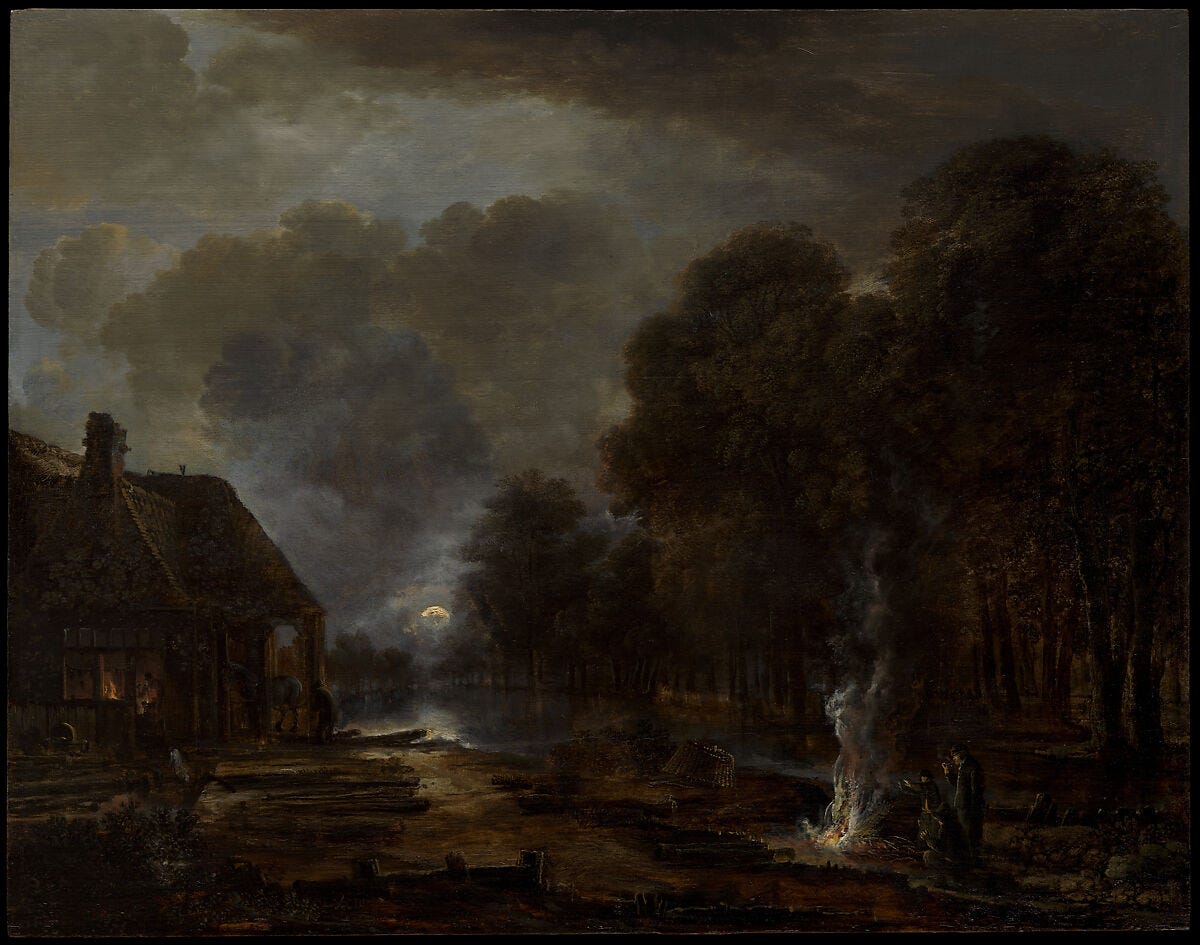
I like waking up before dawn to sit alone in the stillness of the dark. I imagine that at that hour kindly spirits are yet keeping vigil in our midst, mingling with each other and with a living, breathing earth. Once dawn announces the coming of the Sun those kindly spirits return to their burrowed homes deep within some unmanned, distant wilds. The living, breathing earth disguises itself in a cloak of rigid hibernation until mankind shall again sleep. But in the darkness of that final nocturnal hour, before the Sun arrives and Man awakens, the spirits are there: awake, alive, whispering to each other (lest they wake up a human) in some mystic, ghostly tongue. That final hour is quieting, and haunting.
But that day…
My eyes opened, and I registered the dim light of early morning. I was still in a state of groggy, partial consciousness, but I was able to approximate a time of day by judging the tone of grayish light coming through the blinds onto the white wall of the living room I was in. It was already later than I’d hoped. I thought to get up and out of the covers, but my apartment was cold, and it was very, very warm under my favorite blanket.
My eyes closed, and I began to settle back into a slumber. Then I remembered it was my birthday.
A singular birthday wish came to mind; nothing more, nothing less: I thought to myself, I wish to start my birthday by praying a Rosary. And then I remembered the Good Bishop, Jean Marie.
One night about three weeks before Christmas he was lying in his bed, unable to sleep…As the night wore on, the bed on which the Bishop lay became a bed of thorns; he could bear it no longer. Getting up in the dark, he looked out of the window and was surprised to find that it was snowing, that the ground was already lightly covered. The full moon, hidden by veils of cloud, threw a pale phosphorescent luminousness over the heavens, and the towers of the church stood up black against this silvery fleece. Father Latour felt a longing to go into the church to pray; but instead he lay down again under his blankets. Then, realizing that it was the cold of the church he shrank from, and despising himself, he rose again, dressed quickly, and went out into the court, throwing on over his cassock [his] faithful old cloak.1
Unlike Bishop Latour, I had no grand church to gaze upon. However, my mind’s eye stared longingly at the luminousness of other holy things: my icons, my candles, and my rosary beads. It fixed itself, too, on the time-worn yet tender face of this gentle Father2 whose story, once discovered, had ripped a healing wound through my heart. All these things broke past the citadel built up around my slothful, groggy soul, and a steady stream of visceral desire began seeping out within me—a visceral desire for the divine—until I willed to wake.
I rose up into the cold of my home, and I prayed.
I did not think to rise as though it were the best thing to do. Nor was I constrained to stand by conscience as though it were the right thing to do. No, I did not even rise because it was my duty. I awakened for love. A love and longing for beauty. Like a wine that warms or a scotch that soothes, the beauty of my beloved holy tokens restored a healthful vitality to my stolid limbs and capacitated me to rise and stand aright with fear, with wonder, and with desperate longing for the Divine.
There are many days when I open my eyes in the darkness before dawn but hesitate to rise. I lay comfortably under the warmth of my blanket, half-awake, and in a partial slumber I think to myself, I don’t need to wake up right now. Some days that’s all it takes to put me back to sleep. But then there’s the days when a grace fills me, and I hear the haunting beauty of the Final Hour slipping away moment by moment, and I remember.
Waking up early is not necessary.
But the best things in life never are.
And on those days, by God’s mercy, I forge the will to rise — for beauty’s sake. I sit, I watch, I listen to the song of spirits and earth under the cover of darkness; and the mystery of that Final Hour slowly begins healing my soul.3
Willa Cather, Death Comes for the Archbishop (New York: Vintage, 1990), 211.
I am speaking here of Bishop Latour, the main character of Willa Cather’s novel from which I quoted. Latour joins the ranks of other fictional personages in my life—like the beloved Dr. Keating (Dead Poets Society) or Clarisse McClellan (Fahrenheit 451)—who might as well have been living persons. The lasting impression of these characters on my life is of a depth and quality which I have yet to fully define, but suffice it to say that they are genuinely (to me) as real as any other. I am moved by their beautiful existence: even if that existence is a fictional one. After all, who ever said fictional was the same as “not real?”
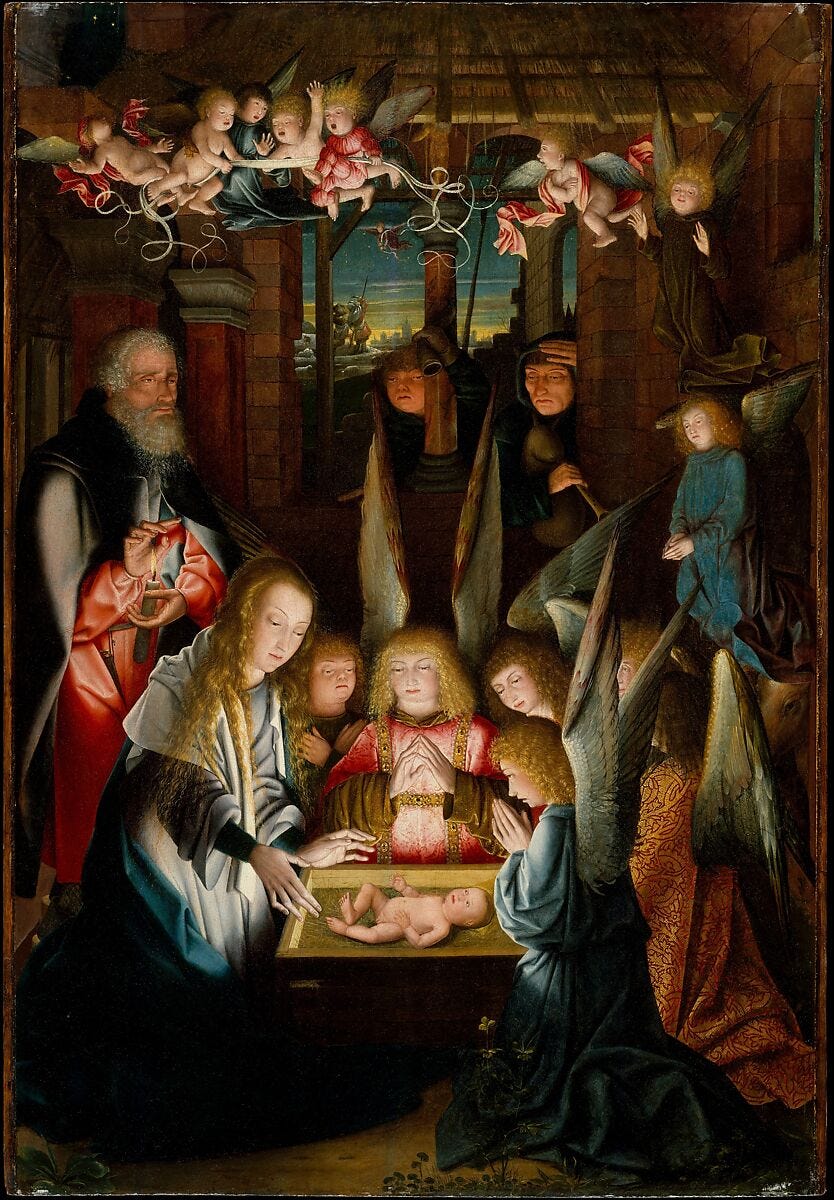
Take note of distant horizon in the last painting ( The Adoration of the Christ Child ), and note that it the hour is late (or is it early?). The dawn—both an end and a beginning—has come.
But the painting is not about the distant horizon, but the Christ Child who is near to us in the foreground. He himself, the Dawn from on High, hath visited us in the stillness of holy darkness, of enlightening darkness. This is our Final Hour: Christ himself whose advent is the world’s Final hour, and the First Hour of that kingdom which is and is to come.
Let us not grow weary, but rather watch and pray. For the time is fulfilled, and the kingdom of God is at hand (Mark 1). We are living in the Final Hour.
Brothers: it is later than you think. Hasten, therefore, to do the work of God. (Fr. Seraphim Rose)